

by Peter Engelmann, July 23, 2026
“The next battlefield is not only where forces manoeuvre. It is where people interpret what is happening.”
Introduction
I came across the term “cognitive warfare” in 2023, when I watched a lecture by Austrian Army Colonel Markus Reisner on the Austrian Army’s YouTube channel. I was immediately fascinated because everything felt familiar to me.
As a producer, writer, creator of fiction content, and dramaturge for many feature films, I thought, well, this is in many ways similar to what we are doing when he was talking about influence operations addressing the heart and mind of target groups.
Of course, we usually do not wage war; we are supposed to create art and entertainment.
However, dramaturgy is strongly rooted in rhetoric, the art of convincing an audience, and this is what we do when we create a film: we make an audience believe in the most fantastic things. In thrillers, we manipulate the audience in a way that they suspect the wrong person to be the villain, or we set up a completely wrong theory about a case (The Usual Suspects), only to prepare a huge turning point when the truth is revealed, or the whole “reality” in the movie falls apart (“The Sixth Sense”) This is both done with dramaturgy and audiovisual immersion.
Moviemakers and writers shape the perception of their audience. Start with convincing storytelling and creative use of cinematic tools – think of Ghostwatch (BBC 1992) or The Blair Witch Project (1999), which spooked whole nations. The most famous example of how fiction can affect perception is Orson Welles’ legendary radio drama War of the Worlds” from 1938.
In recent days, there has been a lot of discussion about what we mean by cognitive warfare and what kind of threat arises in the cognitive domain. The massive use of cognitive warfare in election interference (U.S. 2016), changing the course of whole nations (Brexit), and the use of reflexive control (nuclear fearmongering by Russia) to alter the decision-making of governments and military underline the urgency.
Brexit might be among the most compelling examples of the danger of cognitive warfare:
“According to Miller (2023), the Brexit campaign was shaped by emotional manipulation, identity politics, and cognitive biases. External actors, including Russia, are thought to have amplified the prevailing dynamics through social media manipulation, spreading misinformation and stoking nationalist sentiment.” (Fewer Bullets and More Brains: | www.devissues.nl)
It is extremely important to bear in mind that cognitive warfare and propaganda are not the same. Cognitive warfare isn’t always easy to grasp and triggers conceptual discussions (example: NATO StratCom Conference in Riga 2026).
Films are a great tool to learn and to better understand what it is. In other words, if you want to learn about cognitive warfare, learn from Alfred Hitchcock, Stanley Kubrick, and Steven Spielberg.
This doesn’t mean that the art of filmmaking is bad in any way; quite the contrary, its “manipulative” techniques can be great eye-openers, as, for example, the classic “Witness” with Harrison Ford, which showed the dilemma of a society committed to nonviolence (The Amish people) when confronted with violence. Films can be a great tool to strengthen resilience and support and stabilise the values on which a democratic society is built.
Building both cognitive resilience (through films and all sorts of communication) and understanding cognitive threats (cognitive warfare, propaganda, infowars) is crucial in times where total defense becomes an increasing necessity for European nation-states:
Psychological defense is part of a total defense doctrine: “Civil Defense. The resilience of civilian society, ensuring that the state can function under strain through preparedness, emergency response and continuity planning. However, modern Total Defense strategies often incorporate additional pillars. Psychological Defence – Ensuring national morale, unity and resistance against foreign disinformation, propaganda and subversion” from: Territorial Defence: A Citizen-Soldier’s Handbook by Niclas Hansemark, https://www.amazon.com/dp/9199045605?lv=shuf&channelId=500&plpRedirect=mhFallback
The role of the entertainment industry in the whole context of shaping the political landscape and resilience is not a theoretical one: The interdependence of film and media and geopolitical developments, which require psychological defense, is demonstrated and monitored in the annual Nostradamus Report by the Göteborg Filmfestival, for example in the 2025 report:
“In an age of systemic instability – be it democratic backsliding, escalating climate crisis, or accelerating technological developments – traditional forecasting is less useful than strategic preparation. Today’s challenges require a different kind of resilience: structural, strategic, and shared. It’s crucial for the industry to stop resisting reality in order to resist its consequences.
And important: “In the next 3–5 years, this industry will resist democratic backsliding or become implicated in it. We must fight restrictions on editorial and artistic freedom, including institutional self-censorship; push back against hateful narratives and
populist framings of contentious issues; and proactively create policies, strategies,
and tools to protect individual employees, artists and partners from harm. Telling
complex stories is resisting dehumanisation.”
”https://goteborgfilmfestival.se/en/industry/nostradamus/nostradamus-reports
1) What is happening in film and in cognitive warfare?
Influence is the keyword here.
But what are we influencing?
We influence the perception and the belief system of viewers.
What does that mean? To illustrate this, we can use a hypothesis about the UFO phenomenon by researcher Jacques Vallée (the truth behind UFOs is irrelevant here; this is just for comparison:
“Jacques Vallée is perhaps best known for his challenge to the traditional extraterrestrial hypothesis — that UFOs are physical visitors from distant planets. Instead, Vallée proposes that UFO phenomena may be part of a far more intricate control system that influences human consciousness and perception. This system operates through a combination of psychological, cultural, and metaphysical forces that manipulate how individuals and societies interpret reality.” (George Cassidy Payne, Medium 2025)
This is not so different when we sit in a movie theatre and are exposed to a variety of audiovisual stimuli. Indeed, we influence the perception and the belief system of viewers.
However, here comes the important distinction:
- Movies use dramaturgy and other tools to shape their viewers’ beliefs and perception to make the story work and to entertain the audience.
- In the long run, the value systems of movies shape belief systems in society. This is why movies were often used as a powerful and immersive tool of cognitive warfare. Films combine visual storytelling, music, and effects, which work more on a sensory rather than an intellectual level. In the long run, they can shape societal narratives, “circumvent” rationality, and engineer the mental frameworks through which populations perceive reality.
However, this is not the same. Two different things, but both have to do with dramaturgy and audiovisual storytelling.
If we want to use filmmaking as a reference to understand the deeper grounds of cognitive warfare better, we need to focus on dramaturgy first.
Film dramaturgy is the art, technique, and science of structuring a story’s elements into a deliberate dramatic order to maximize emotional and thematic impact on the audience. It serves as the underlying architectural framework of a movie, dictating how a plot unfolds regardless of real-world chronological time.
Here it is: In film dramaturgy, we aim to maximize emotional and thematic impact on the audience.
That’s what any speaker does when it structures his speech. What we do here is rooted in rhetoric.
Rhetoric is the basis of everything.
Rhetoric also deals with how to persuade someone. Think of the lawyer who appeals to a jury in Court.
Rhetoric is the conceptual foundation where we start. Therefore, understanding filmmaking and dramaturgy means understanding rhetoric. It means that films could be seen abstractly, like a sort of text or speech that aims to persuade its audience.
In other words, all ways lead back to Aristotle. The philosopher both defined dramaturgy (Poetics) and rhetoric.
But how does that relate to cognitive warfare or the cognitive domain in general?
“NATO STO (2025) considers human cognition as a strategic challenge.
Wars were never limited to missiles, tanks, and troops on the ground. Rhetoricians in Ancient Greece understood that shaping perception could be as decisive as any battle (Henschke, 2025). What is unprecedented today is the technological infrastructure behind these timeless strategies. It allows them to scale globally in real time and target civilian populations as easily as military ones.” (Mykolas Katkus, What is cognitive warfare in modern information wars)
Here is the common denominator again: Shaping perception.
And as Maria Russo said: Before people decide what to believe… before institutions decide how to respond… before political leaders make decisions…they first interpret reality.
Learning from the movies in this context means learning how cognitive warfare works.
However, before we dive deeper into the cinematic techniques of influencing our perception, we must remember one big difference:
“When we watch a movie, we knowingly suspend our disbelief. You pretend that what you’re watching is real so you can enjoy it. You allow yourself to imagine the film’s reality so you can engage emotionally.
During those two hours, your critical faculty – the filter distinguishing fantasy from reality – is lowered. While you still “know” it’s fictional, your unconscious is more open to suggestions. “(Adriana James, How Movies Affect the Unconscious Mind and Shape Your Behavior)
Subsequently, there is still a conscious decision when watching a movie to lower that critical faculty, whereas propaganda and cognitive warfare aim to circumvent that critical faculty.
Nevertheless, it doesn’t make a difference if we look at the techniques of dramaturgical and cinematic mind control.
2) What kind of techniques do narratives involve to influence us by controlling our emotions?
Examples:
- Appeal to our core values. Nearly everyone has a strong sense about justice/injustice: Many classics (books and dramas) work because the main character is a victim of injustice. A prominent example is “Gladiator”, where Maximus becomes the victim of Commodus. In movies, often the order is disturbed in the beginning, and the story unfolds as to how to restore the order of things. Obvious examples are Jurassic Park or The Fellowship Of The Ring.
- Insinuation is to influence an opinion without directly saying explicitly that something is good or bad. The “insinuatio” in a film is usually part of the first act and creates sympathy for a character and his case or leads our perception in a certain direction. For example, Psycho (1960): The opening scene shows Marion Crane and her lover in a hotel room during a lunch break. It heavily insinuates a story about illicit romance and financial desperation, completely misleading the audience about the horror film it actually becomes.
- Use empathy: Most films create empathy for their main character or a group of characters. This is one of the most important techniques because the filmmaker wants the audience to emotionally relate to the character and his fate.
Attention control. Attention control is the classic Three-Cup Trick. Luring the audience’s attention in one direction while doing something they are not aware of in the same moment.
Again, Hitchcock is the master of this: He used the condition that we automatically follow any motion to trick the audience. Let a rabbit run through the scene, and you might miss important developments elsewhere
Hope vs Fear. Any drama or even nearly any story in most genres revolves around the question of what we hope for or what we fear. As in real life, we constantly think about what will happen next to the person, whether there will be a happy ending or what lurks in the dark. Horror Movie and thriller directors are experts in exploiting our (hidden) fears; will Martin Brody escape the shark, or can Doc Hallorann save the family in time (The Shining)? Can Clark escape the mysterious backrooms (Backrooms)? Can Jon Snow save Westeros (Game Of Thrones)?
- Mockumentary – The Staged Verification. Example: “Ghostwatch manipulated its audience by presenting a fabricated supernatural investigation as a legitimate, live BBC broadcast. By utilizing trusted real-life presenters, encouraging viewers to call in.” ( https://www.moviejawn.com/home/2025/8/4/weird-history-ghostwatch-feature)
Many movies claim they are based on a true story, even if they are not. The Blair Witch Project used the found footage principle to claim that the events are true.
The idea here is not only the usual “suspension of disbelief” as in any fiction but to make the audience actually think this is for real.
- Strategic ambiguity: Often the moviemaker deliberately gives us contradictory clues about what’s true or what’s really going on. This makes scenes more memorable and challenges viewers to engage with the content. David Lynch was a master of ambiguity. A modern example is the Backrooms, where there is ambiguity about which plane of reality the Backrooms actually exist in.
These are only a few examples of how films control their audiences.
3) USAGE
Understanding film dramaturgy can help identify cognitive warfare and develop strategic communication.
- The first example of justice/injustice is used pretty often in propaganda. We see it very often not only in blatant lies but in “sad stories” which circulate like urban legends. The purpose is often to undermine the government in a way that the story creates the image that normal citizens suffer, for example, because the “immigrant is preferred,” etc.
- Insinuation happens all along: Often, it is a story in which certain elements are omitted to manipulate opinion. It is the combination of elements that is used to trigger emotion. The difference between insinuation and justice/injustice is that it is much more subtle, not like a straight accusation or argument. It is used to create a certain impression.
- Empathy: Creating empathy for one side is a very common and sometimes simple tool; for example, images with children or cats to influence the opinion. In strategic communication, it is important not only to create empathy for a certain person, party, or good cause but to be empathic.
- Attention control: This is very important for any cognitive warfare where deception is involved. It has a long tradition in the military sense: the simple case is to create the impression that country A is under attack, while the attacker targets country B in a surprise attack.
- Hope Vs Fear: Fearmongering is very obvious (nuclear threats), but as in the movies, people get manipulated mostly by a play with fear and hope. The enemy sends both encouraging and threatening messages to put the defender in a state of insecurity. But the dramaturgical technique can also be used to keep attention alive if the outcome of a certain action is unclear.
A typical example of a hope-vs-fear game is offering negotiations and communicating readiness to make compromises, only to attack the next moment. Black sheep in business use hope vs. fear techniques very often: The promise of payment within two weeks just to fail to do so and then reiterate the hope, followed by further disappointment or even threats.
The insecurity that arises when someone is constantly confronted with hope vs fear can be used to keep attention alive and for reflexive control: In the series GAME OF THRONES, there is a constant hope vs fear situation that keeps the audience glued to the series; in real life, Donald Trump’s unpredictability grants him constant attention.
But even more russia and other bad actors often create whole dramas, for example, about alleged threatened russian minorities with hope and fear games. It’s not only a few lies but a whole story that works as a drama. The trick was also used by German Nazi propaganda as a preparation for the assault against Poland in 1939.
- Mockumentary & false verification: Russia developed a sophisticated system to deceive the West. This goes way back in history:
Soviet intelligence developed the matryoshka system of deception:
“Here’s how it worked: When one deception was uncovered, the Soviets wouldn’t just admit defeat. Instead, they’d immediately present their targets with new, seemingly independent sources that appeared to expose and verify the original deception. But plot twist – these new sources were also controlled by Soviet intelligence! https://www.linkedin.com/pulse/art-russian-deception-matryoshka-system-soviet-robert-nogacki-lxicf/
In the end, no one knows what is true and what is wrong. This is a technique often used by authoritarian systems to break resistance and to form public opinion!
We see agents of chaos sowing contradictory information or lies on the web and in social media all the time. This is one of the main challenges in the times of hybrid warfare.
- Strategic ambiguity: An experiment conducted during Mare Aperto, the Italian Navy’s largest annual joint exercise about Perception as Battlespace, revealed that “Ambiguity may be more powerful than falsehood: Actors whose identity remained intentionally unclear, mixing irony, satire, neutrality, or hybrid positioning, generated disproportionate levels of interaction and interpretive disagreement”. (https://www.linkedin.com/pulse/when-perception-becomes-battlespace-what-military-exercise-sara-russo-u9gre/)
4) The toolbox of propaganda AND dramaturgy:
Apart from storytelling techniques, both films and cognitive warfare use tropes, topos, clichés, and established signs as tools. The image of the White House can replace a whole explanation, as it stands as a symbol for power and the government. The alien mothership above the White House in Independence Day signals ultimate danger without further explanation. It is no coincidence that we often see prominent buildings or locations in movies.
Visual iconic signs, typical character traits, cultural beliefs and prejudices, popular myths and urban legends, spiritual beliefs, sayings, and most importantly, defining values are constant tools in the storytelling of films and cognitive warfare.
Without the use of preexisting concepts and signs, our films would be many hours long, not two hours long.
And without the knowledge about belief systems, myth, and defining historical narratives, short propaganda sentences, which work like mental malware, like a computer worm, wouldn’t have their dangerous brainwashing potential.
Cognitive warfare always deals with our values and norms in the first place to manipulate our belief system. Movies discuss our values and norms and, indeed, change our belief system too.
Movies can also be good for understanding the importance of affective impact (= resonance factor). Sometimes, when a movie triggers very strong emotional responses from its audiences, the reason is that the movie refers to a deep emotional experience the viewers had. An example is Wolfgang Petersen’s The Boat, which dealt with World War II experiences but from the point of view of German navy members. Cognitive warfare uses affective impact in many cases, for example, to trigger existing fears.
Russian propagandists often use the “don’t poke the bear” metaphor because they know that fears stemming from the last months of World War II, when the Red Army brought unspeakable horrors to East and Central Europe, run deep in families till today.
5) Katharsis as an antidote to cognitive warfare?
Stephen King described in his book Dance Macabre how the paranoia and alien invasion movies in the 50s prepared the mindset of American audiences for territorial defense: After the Sputnik Shock, the nation was in turmoil and feared communism and the Soviet Union, which led to the culmination of the Cold War during the Cuban Missile Crisis.
Hollywood delivered a huge number of genre pics, which were horror and science fiction thrillers. Indeed, the movies had a defining power shaping the genre til today. Their purpose was entertainment, and they were not “ordered” by the government to convey certain messages, but they also developed a political dimension.
Earth vs Flying Saucers and all the genre pics raised a sense of urgency – Watch The Skies! even though there was no imminent Soviet invasion to be feared.
Furthermore, movie classics like “Body Snatchers” fed a sense of paranoia that your neighbour might not be what he seems to be. In the movie, humans are exchanged for identical alien replicas which behaved a little differently. It doesn’t take too much fantasy to detect metaphors for Soviet agents here.
Alien invasion moves are a training ground to teach endurance and confidence. The science-fiction movies also invoked the American topos of “pioneer spirit”. No alien invader can overcome this pioneer spirit.
Of course, we are not wrong to think that these movies also had a propagandist, a cognitive warfare aspect.
But perhaps the most important aspect is the catharsis effect horror movies have: In the movies, Earthlings survived the alien invasion, and it became a kind of substitute experience to better deal with the frightening effects the Sputnik shock had on the young American generation, a sort of catharsis.
The interesting aspect here is that catharsis has a healing aspect; in the original Aristotelian sense, it has a purification aspect, which is quite the opposite effect of most cognitive warfare, which aims to destroy a society or a nation rather than to heal it.
Whether movies or other storytelling arts that have a cathartic effect can be used as an antidote to cognitive warfare is an interesting field for further research.
It might also be noteworthy that if our modern, today’s Western societies lack the opportunity for catharsis and healing rituals, these societies are more vulnerable to cognitive warfare attacks.
6) Audiovisual Immersion
Dramaturgy is the pillar of the building. The screenplay is the blueprint. The narrative is the very supporting structure that keeps everything in place and prevents things from falling apart, but the most important thing is how the movie is done with cinematic means with audiovisual tools.
Audiovisual immersion or audiovisual storytelling is more like music. It is the sensual, pure emotional and physiological experience: the scary set-pieces in a horror movie which cause adrenaline to surge, the impact of memorable scenes working with outstanding cinematography, the sense of awe created by stunning visual effects, and the deep emotions triggered by moods, soundscapes, and soundtracks. It’s everything we call cinematic.
It is, of course, an old discussion about how much these elements serve themselves, if they are the truest expression of the cinematic arts, or if they serve a purpose of influence. They can be both or one of them.
Describing the audiovisual immersion or the “cinematic” is more difficult than describing techniques of storytelling or rhetoric. It can, however, be interpreted as a form of rhetoric, as something which can be translated into text; however, it needs lots of work to write the protocol for what happens in a scene on the audio track and in the image: camera movements, noises, changes of colors. A method to describe film as text was developed in the film philology department of LMU Munich by Professor Klaus Kanzog.
It is important to understand that audiovisual immersion is a key to either creating powerful messages or better understanding cognitive warfare: Whenever something is told with images, we need not only be aware of text-signs or audio-commentaries but also of the imaginary, the moods, the symbols, the sensory effects which can affect us on the deepest levels.
A famous and notorious example of a bad influence is Leni Riefenstahl’s Triumph Of The Will, which doesn’t lecture the audience with simple propaganda but uses powerful images.
There is a reason to argue the influence of movies in the digital, AI, and social media era. Certainly, there is a shift from influential movies towards the myriad of online videos. However, understanding film and cognitive warfare helps us to understand the foundations.
“Defending our democracies and even our mere territory means gaining Mental Sovereignty, as the ultimate strategic goal, helps populations maintain a stable perception amid engineered chaos.”
Again, this challenge is not just some additional threat; it sits at the core of the societal disruptions happening in our time:
7) SITUATION ASSESSMENT:
The recently released Chief Scientist Report NATO regarding cognitive warfare from 2025 informs about the strategic reality of the increasing threat cognitive warfare poses to Western societies.
“Cognitive Warfare seeks “to exploit facets of cognition to disrupt, undermine, influence, or modify human decision-making by altering human behaviour and cognition through any means and technological advances”. It uses military and non-military tactics, targeting both military operators and civilian populations across the crisis spectrum.
Some experts argue that NATO Allies and Partners are already in an era of continuous warfare, with foreign interference staying below the threshold of armed conflict but still significantly impacting human behaviour.,,,
….Allies and NATO need the appropriate means to detect and analyse Cognitive Warfare attacks, while developing mitigation strategies that increase our resilience to such warfare. Given that Cognitive Warfare poses significant challenges to military and civilians alike, we must pursue a whole-of-government approach to collaborative research, policy-making, strategy development, and resilience planning across responsible ministries involved in defence and security. The STO supports NATO through developing Cognitive Warfare capabilities and strengthening NATO’s knowledge of the cognitive dimension. This includes shaping this dimension to better counter threats in the cognitive battlespace…” From: https://www.sto.nato.int/wp-content/uploads/chief-scientist-report-cognitive-warfare-4.pdf
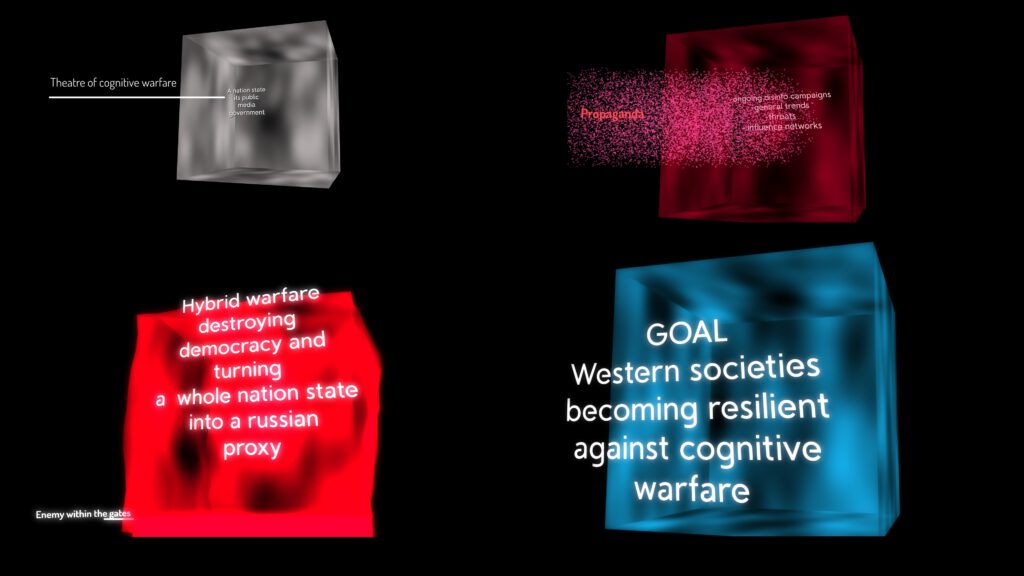
8) THE ENTERTAINMENT INDUSTRY AS A CONTRIBUTOR
The film and media industry is placed in the midst of this ongoing battle: It can change outcomes for the better or worse.
It can provide the necessary tools to tackle the challenge of cognitive warfare, which our adversaries bring upon.
- WARGAMES AND TRAINING:
Simulation. Movies themselves are simulations of human conflict. They explore and demonstrate typical human behaviour and strategic development. Writers and dramaturgs can assess real risk and conflict situations and project potential scenarios. Regarding cognitive warfare and film, they can describe the perceptions of the parties involved and how their perception can change. Existing movies can be used for demonstration and for analysis of archetypical conflict patterns.
Films are a good training ground for total defense.
- Utilisation of films and dramaturgy for understanding cognitive warfare and the development of audiovisual strategic communication. This is especially important as cognitive warfare is not something that can be understood as easily as propaganda.
- We can create cognitive situational awareness, which is important for psychological defense.
- STRATEGIC COMMUNICATION:
The answer to threats in the cognitive domain is strategic communication. Strategic communication uses audiovisual immersion, and dramaturgy is a powerful tool. The entertainment industry can deliver a wide variety of products
– short videos for use on social media and other platforms
– visual models for edutainment, lectures, webinars, or mapping cognitive warfare
– development of YT videos, series, and Movies, which
address the issues of our time.
It is important to note that many of the creative techniques described in previous sections not only apply to films but especially to social media, which has, of course, a pivotal role in cognitive warfare:
“Viewers no longer just read narratives. They experience them emotionally through audiovisual immersion. This makes the content far more memorable and far harder to fact-check in real time (Yarchi, Baden, & Kligler-Vilenchik, 2021).” (https://repsense.io/blog/cognitive-warfare)
More:
Recommended Reading:
Internet:
Cognitive Warfare – The Fight for your Heart and Mind
https://www.linkedin.com/pulse/when-perception-becomes-battlespace-what-military-exercise-sara-russo-u9gre and https://sararussoresearch.substack.com/p/when-perception-becomes-the-battlespace
Fewer Bullets and More Brains: | www.devissues.nl)
https://www.kyivpost.com/videos/80055
https://www.act.nato.int/article/cogwar-concept
https://www.act.nato.int/activities/cognitive-warfare
https://www.sto.nato.int/wp-content/uploads/chief-scientist-report-cognitive-warfare-4.pdf
https://www.act.nato.int/article/cognitive-warfare-strengthening-and-defending-the-mind
How Movies Affect the Unconscious Mind and Shape Your Behavior)
Books:
Niclas Hansemark: Territorial Defense: A Citizen-Soldier’s Handbook
Klaus Kanzog: Einführung in die Filmphilologie
